Development finance institutions (DFIs) are public institutions that invest in the developing world to spur economic growth. They have played a major role in international development since 1944, when the World Bank was founded. There are hundreds of DFIs of varying sizes, with different sectoral and geographic focuses. According to a 2020 study, 143 DFIs had balance sheets worth more than $3 billion.
The data published here covers 28 DFIs who were invested in the hotel industry through the end of 2022. The largest DFIs included, based on their investment in the hotel industry, are the International Finance Corporation (IFC), the European Investment Bank (EIB), the European Bank for Reconstruction and Development (EBRD), and the Inter-American Development Bank (IADB). Most of their hotel investments are in Asia, Africa, and Latin America, with Mexico and Sri Lanka receiving the largest investment amounts. The present study does not include Chinese development banks, which also invest heavily in the hotel sector.
Governance Structures:
DFIs operate under a variety of governance models.
Multilateral development banks (MDBs)are managed by multiple shareholding governments who provide capital to the bank. MDBs include the Asian Development Bank (ADB) and the European Bank for Reconstruction and Development (EBRD), among others.
The DFIs managed by national governments, by contrast, are called bilateral development banks (BDBs), such as the British International Investment (BII). While public authorities dominate DFI boards, some DFIs have nongovernmental shareholders. For example, the Dutch development bank (FMO), counts Dutch trade unions and banks among its shareholders.
Several DFIs are part of larger international institutions. The International Finance Corporation (IFC), for example, belongs to the World Bank Group (WBG). The European Investment Bank (EIB) serves as the lending arm of the European Union.
Some DFIs focus on a particular region, like the Inter-American Development Bank (IADB), or sector, like the Asian Infrastructure Investment Bank (AIIB).
Many DFIs maintain mechanisms for receiving and investigating complaints. Some operate within existing management structures, like the IDB Invest Management Grievance Mechanism, while others are set apart from the DFI’s main management teams but still responsible to the DFI’s board, like the IFC’s Compliance Advisor Ombudsman or CAO.
Investment Structures:
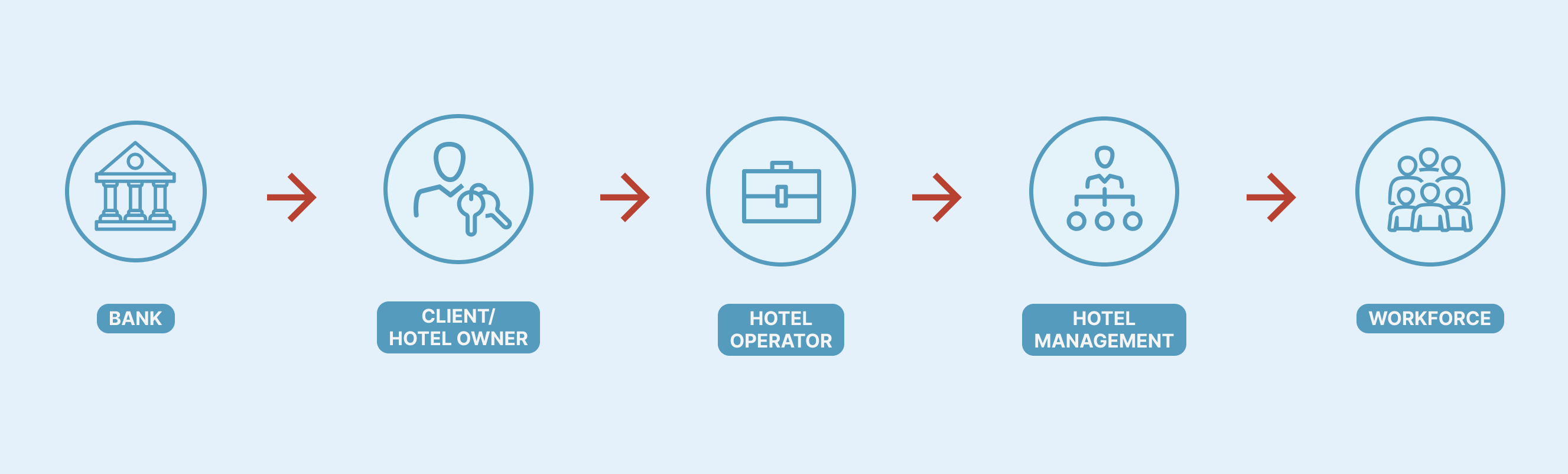
DFIs may finance public or private projects. In recent decades, development banks have increasingly turned to financing private enterprises rather than public projects, and this website focuses on DFIs’ private financing. Projects take a variety of forms. In the hotel industry, for example, DFI projects may be loans to finance the construction, renovation, and/or operation of hotels. In other cases, DFIs may make equity investments in hotel brands or management companies. The companies that apply for DFI financing are typically called clients, who usually contract with other businesses—such as hotel brands and management companies—to operate projects.